Fujian Tulou
Introduction
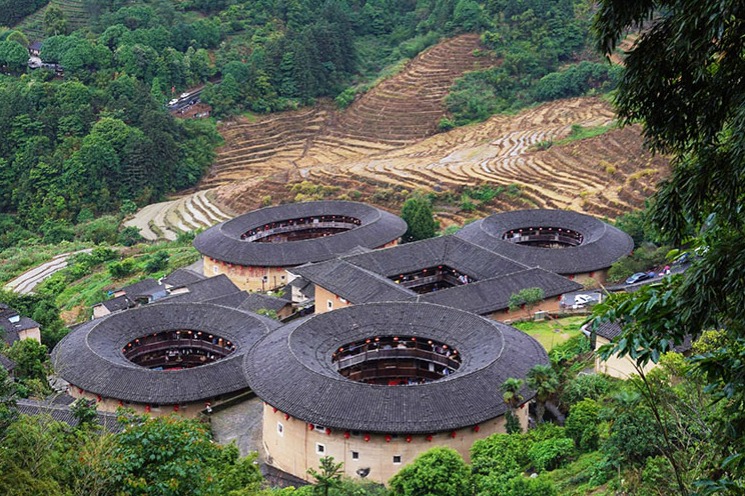
Fujian tulou are extraordinary architectural constructions located in the mountainous regions of southeastern China, specifically within Fujian province. These unique buildings were predominantly built by the Hakka people, a subgroup of the Han Chinese who migrated from the northern parts of China. Currently, there are over 3,000 tulou, mostly circular with some square ones, scattered like pearls across the lush landscapes of Fujian. On July 6, 2008, 46 of these unique structures, built between the 15th and 20th centuries, were inscribed as UNESCO World Heritage Sites. The term "tulou" translates to "earthen building" in English, characterizing these structures made primarily from earth, wood, stones, and bamboo. The buildings are ingeniously designed as fortified communal living spaces that could accommodate entire clans, often housing up to 800 individuals. Their iconic circular or square shapes, with high mud walls and a singular entrance, were originally intended for defense purposes. These buildings are an exceptional example of a traditional communal living style that was developed in response to the socio-cultural needs of the Hakka people while reflecting principles of harmony with the environment.
Architectural Features
Fujian tulou are renowned for their distinctive architectural features, which reflect an ingenious fusion of communal living, defensive strategy, and respect for nature. These buildings are typically multi-storied, with circular or square floor plans centered around a communal courtyard. The outer walls of tulou are constructed from compacted earth mixed with bamboo, stones, and wood, giving them their characteristic sturdiness and defensive capability. These walls are remarkably thick, reaching up to 1.8 meters, and can be several stories high, making them formidable structures against potential threats. The design of tulou is such that there is only one main entrance, fortified with iron or thick wooden doors, providing security to the inhabitants. Windows are strategically placed only on the upper floors, minimizing vulnerabilities. Internally, tulou are divided vertically among different families, with each family unit typically occupying a set of rooms on each floor. Despite their plain exterior, the interiors of tulou are often comfortably furnished and decorated, reflecting the cultural richness and aesthetic sensibilities of the Hakka people. The roof is usually topped with tiles and features wide overhanging eaves, offering protection from rain and heat while contributing to the building's stability.
Historical Development
The historical development of Fujian tulou is closely tied to the migration patterns of the Hakka people, who moved to southern China over several centuries due to conflicts and social upheaval in the northern regions. This migration began as early as the 12th century and continued over subsequent centuries, with the Hakka people eventually settling in the mountainous regions of Fujian. The unique socio-political circumstances of the time necessitated the construction of fortified communal living spaces, leading to the development of tulou. The earliest tulou structures date back to the 13th century, but the large-scale development and the architectural style recognized today were predominantly established between the 15th and 20th centuries. Over time, tulou evolved into highly sophisticated and technically advanced structures, reflecting the development of a unique architectural tradition among the Hakka. With each generation, improvements were made to enhance the structural integrity, comfort, and defensibility of these communal homes. By the 17th and 18th centuries, the most elaborate and well-decorated tulou were constructed, showcasing the artistic and engineering prowess of the Hakka people. As social stability increased, the function of tulou gradually shifted from pure defense to more communal and cultural purposes, while still maintaining their role as central family units.
Cultural Significance
Often described as "a little kingdom for the family" or a "bustling small city," tulou are a testament to the communal lifestyle that has been a cornerstone of Hakka society for centuries. These structures not only served as protective fortresses but also as vibrant centers of community life where large extended families lived, worked, and celebrated together. The communal nature of tulou fosters a strong sense of unity and cooperation among its inhabitants, reflecting the deeply rooted Hakka values of family, harmony, and mutual support. Furthermore, the tulou’s architectural design, which adheres to feng shui principles, highlights the Hakka people's deep respect for nature and their environment. This harmonious relationship between the tulou and their natural surroundings exemplifies a sustainable way of living that has persisted over generations. As cultural icons, Fujian tulou have become symbols of Hakka identity and resilience, continuing to attract interest and admiration from around the world for their historical and cultural richness.
Tourism and Current Use
Today, Fujian tulou are not only architectural marvels but also popular tourist attractions that draw visitors from across the globe. The UNESCO World Heritage designation in 2008 significantly boosted their international profile, making them must-visit sites for those interested in traditional Chinese architecture and culture. Tourist activities in tulou areas include guided tours, cultural performances, and interactive experiences that offer insights into the traditional Hakka lifestyle. Many tulou have been adapted to accommodate modern needs, serving as boutique hotels, homestays, and cultural centers while preserving their historical integrity. The influx of tourism has brought economic benefits to local communities, contributing to rural revitalization and improved living standards. However, the preservation of tulou remains a priority, with substantial investments being made to restore and maintain these ancient structures. Local governments and communities have implemented measures to balance tourism development with heritage conservation, ensuring that the cultural and historical essence of tulou is not lost. Initiatives like converting some tulou into cultural and educational spaces allow visitors to appreciate the living history of these remarkable buildings while engaging with the cultural heritage of the Hakka people.








